
Recent Posts


Fact or Fiction
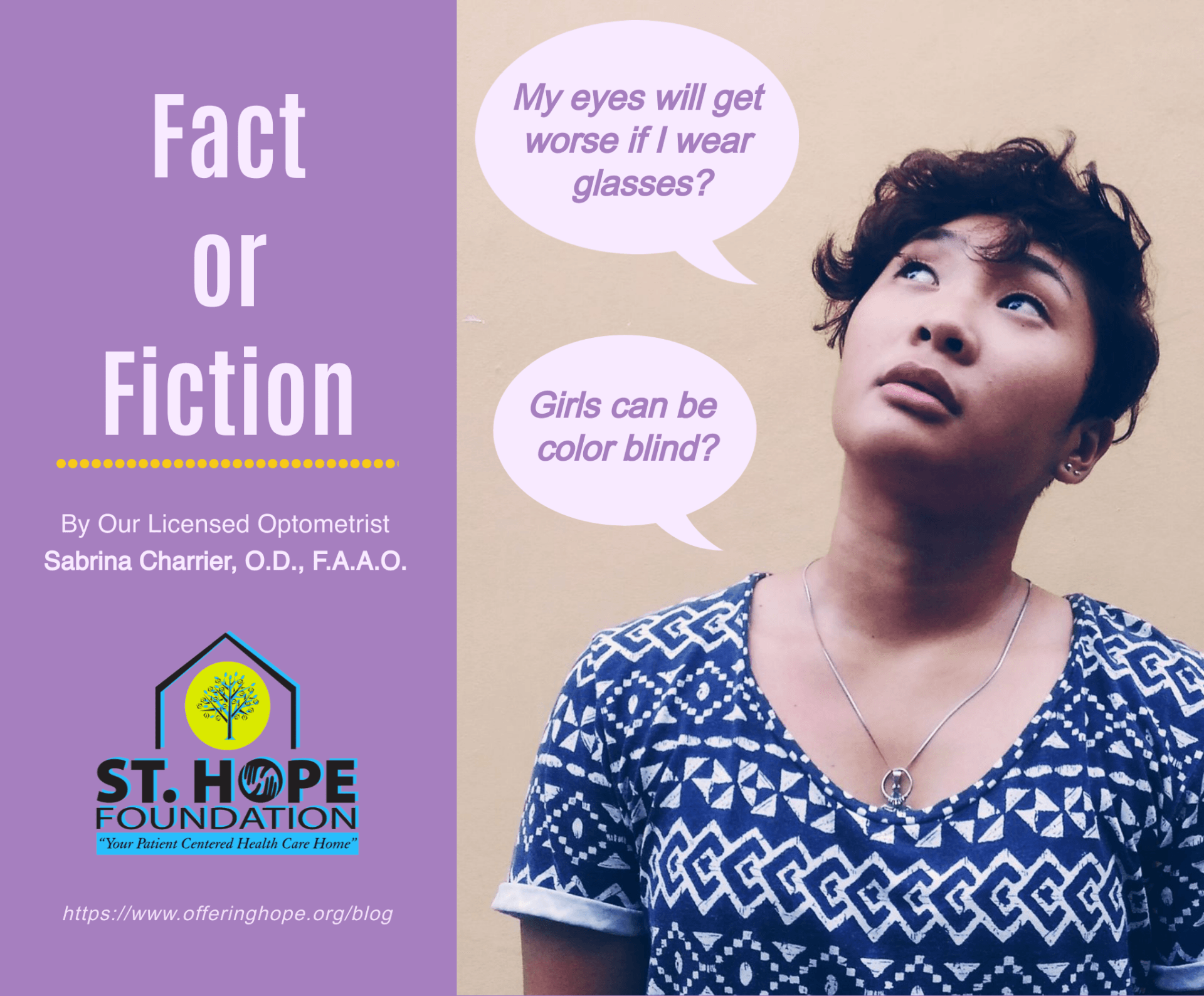
Well intentioned parents and friends in your lifetime have mentioned some of the myths below. We’ve all heard these at one time or another but how many of these are actually true?
If you cross your eyes they’ll get stuck that way?
FICTION! Our eye muscles allow our eyes to look all around, including inwards. Strabismus is a condition where your eyes are truly crossed eyes and is the result of disease or nerve damage, not from forcing your eyes to temporarily cross. Strabismus can usually be corrected, especially at an early age.
Girls can be color blind?
FACT! Boys are just more likely to be color blind (one in twelve) but it does occur in about one in every 200 girls. There are 3 main types of color blindness where it is difficult to tell the difference between red and green or blue and yellow.
Sitting too close to the TV will ruin your eyes?
FICTION! While staring at a TV all day may cause eye strain or tired, blurry eyes, it will not permanently damage your vision. Screen time should be minimized or you should take regular breaks to rest your eyes. If your eyes dry out causing the blurriness and eye strain, ask your eye doctor about helpful eye drops.
You see things upside down and your brain turns the images around?
FACT! The lens of the eye makes an upside down image onto our retina and then our brains take the images from each eye and creates a single right-side up image.
All your eyes do is process light. It’s your brain that creates the picture. First, your eyes take in light and convert it into electrical nerve signals. They travel to your visual cortex, the part of your brain that controls sight. It converts the signals into the image you see.
Contact lenses can get stuck behind your eyes?
FICTION! There’s no way a contact lens can slip over the top and get stuck back there forever. The area between your eyelid and eyeball is enclosed in a pouch called the conjunctival sac. The contact can’t get past it. Flush your eye with saline solution to wash out a misplaced lens.
Eye color can’t change after you’re a baby?
FICTION! Most babies are born with gray or blue eyes. During their first year a baby’s eye color may change from a bluish gray to brown. By about age 6 your eyes are the color they’ll be for the rest of your life. It’s rare, but your eyes could change color when you’re a teen or young adult. The cause is in your genes -- if a family member’s eyes changed, it’s more likely yours will, too.
My eyes will get worse if I wear glasses?
FICTION! Your eyes can change as you get older but that’s going to happen whether or not you wear your glasses. You can’t wear your glasses too much. They do not cure any eye problems but they do help improve your vision and eye strain while wearing them.